10 years anniversary
10 years ago, a complaint was filed on Constitutional Court by my legal representative filing number RVP 2274/09 from 22. 12. 2009 which is registered under file number I. ÚS 472/2010. We haven't received an answer since.
An inventory of the story under the name CAUSE PEPSI BLUE might also be suitable as a theme for a film, it would only be difficult to determine under what kind of genre such a film could be included. This case carries elements of the genre from adventure to horror and the drama is that it is a reality in Slovakia. The effort to implement blue cola, ie cola for Slovakia in blue, upon accession to the EU and the visibility of Slovakia in such a historical event brought an interesting situation where the case was taken over by a certain power in the state. There was economic damage without the possibility of protection against this power.
Without the principle of justice and the principle of legal certainty, there can probably be no patent office and state that takes fees for its actions and creates a sense of security on the part of the law and the state for the author or innovator and then stands as if opposed to him, while it has kept its own written rules of the game, which apparently no longer apply to everyone equally. The state will organize a court hearing without allowing the plaintiff to attend and will decide for himself.
„The best protection of the idea in Slovakia is if you do not say it.“
Limited series and world primacy for the PEPSI Group and liquidation for the author. In the course of 2003, the planned production of colored cola beverages was stopped for Slovakia and for partners in the surrounding countries. The reason was legal uncertainty in further proceedings in this project, which apparently began to be blocked by a certain power in the state.
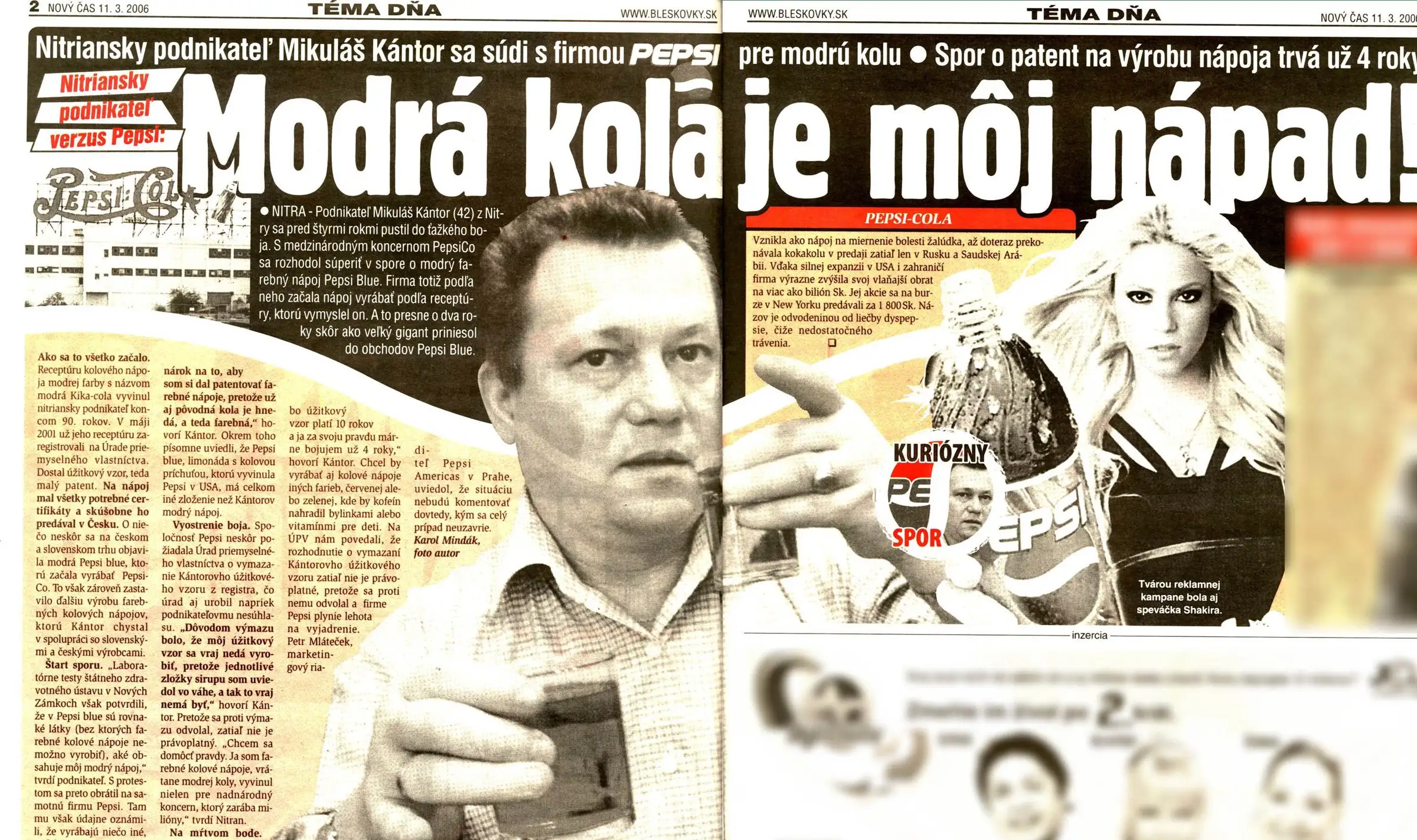
In 2009, it was decided to apply to the Constitutional Court for violations of fundamental human rights and freedoms under Article 46, paragraph 1 of the Constitution of the Slovak Republic, and 2019 is the 10th anniversary of this submission and this complaint, which is still unanswered. The economic damage and the continuing damage directly related to it, the constant damage to the good name on which each company stands, led me to the decision to publish the origin of blue cola on the basis of documents and supporting documents.
During the period from the inception of the dispute to the present day, the state has separated the inseparable, guaranteed by the law and the Constitution of the Slovak Republic, from our company property intended for business, for the benefit of third parties, which sold this property. The unenforceability of our rights in several ways significantly affected the economy of the company and, last but not least, the family.
In the given case, Slovakia probably stood against Slovakia, against its citizen and probably at least against the Slovak national color. For comparison, the Slovak double cross also stands on the elevated top of the blue three hills.
Legal uncertainty has hindered and continues to hinder business in Slovakia. It is probably impossible to invest in business by entrepreneurs – investors, unless the state power protects their business intentions, but apparently with a good project that opened up competition to a multinational concern it takes over the damage and economic liquidation of the author.
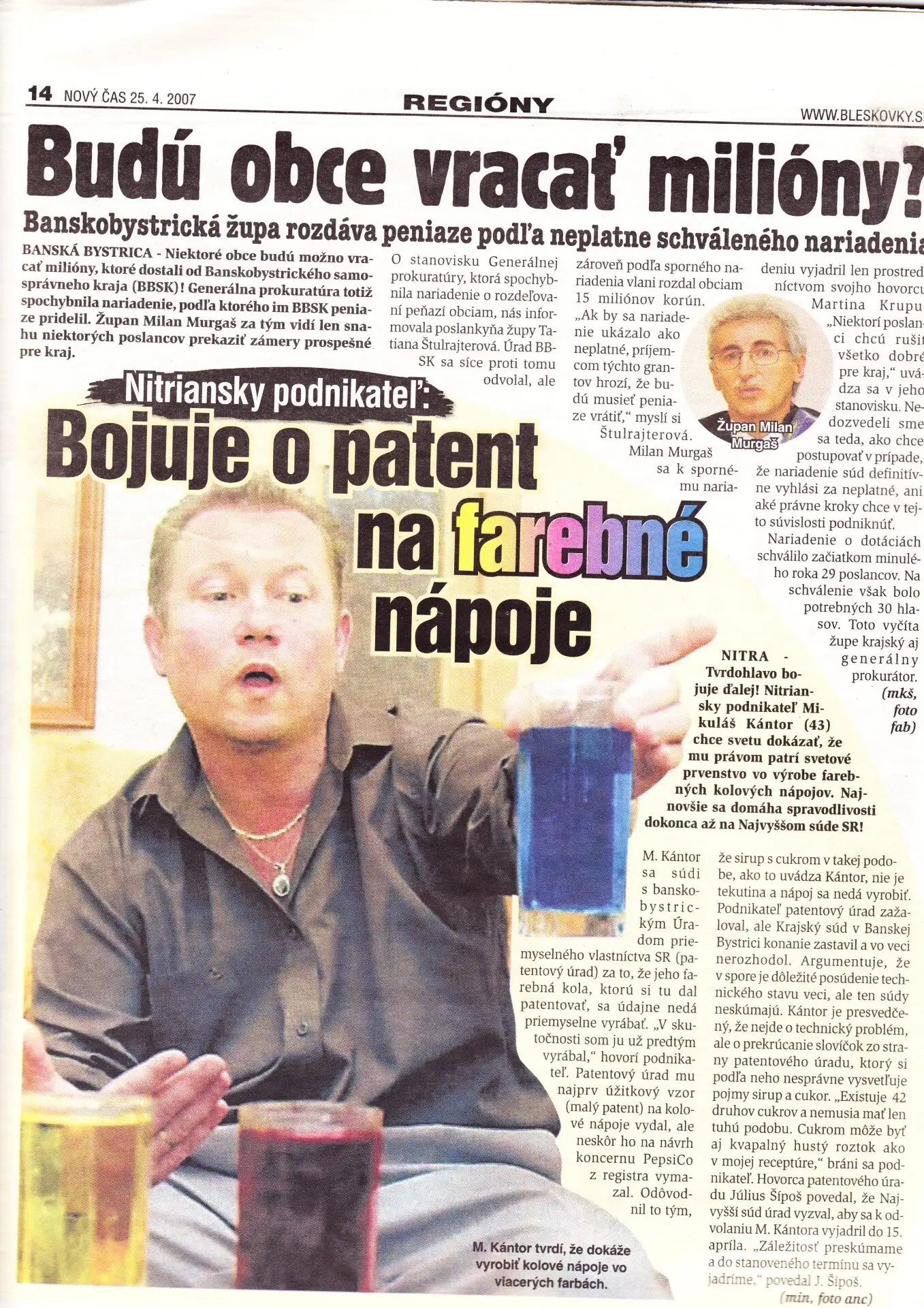
Initiation of a lawsuit under the name CAUSE PEPSI BLUEBeginnings of the production of cola-flavoured lemonade in blue
The Slovak Republic, which was negotiating its accession to the EU, has blue in its national symbols, and for this reason a plan was prepared for the production of cola beverages in colour versions with a pilot blue cola. Colour changes of other well-known products took place long before colored cola beverages appeared. The high interest and marketability of CURACAO BLUE liqueur provided the basis for experimenting with the colors of well-known products such as ZUBROVKA for ROSÉ ZUBROVKA, KORD VODKA for purple VODKA CASSIS or for red VODKA Cherry, yellow RUM DAIQUIRI, etc. This also provided the basis for the idea of colored non-alcoholic cola drinks with a pilot production of blue cola.
Due to the courage of production and the change of color of cola, there was no producer in Slovakia in the beginning who would like to enter the project together. With the words “Who ever saw a cola that was blue”, a manufacturer from the Czech Republic finally joined the cooperation. By an agreement on exclusive production and cooperation in the representation of this producer for Slovakia and the surrounding countries, he was provided with KNOW-HOW for the production of blue cola.
Jožko Stümpel and later N-radio under the direction of Jarek Dóczy were also very helpful to us with advertising for products at that time. Due to the intervention of the PEPSI Group with its PEPSI BLUE production in Slovakia and the Czech Republic, a letter was sent in 2002 to the company PEPSI-COLA, s.r.o. Slovakia. The group's response was brief and worded that they were doing something else.
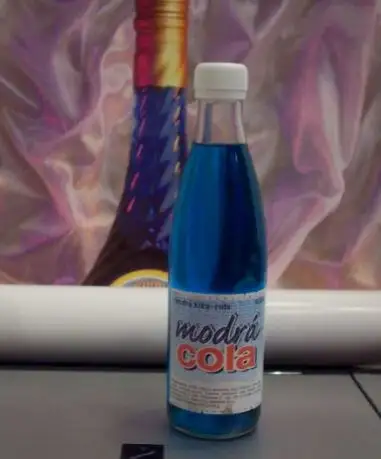
The solution of colored cola drinks, e.g. in blue, was not known in Europe at that time, and the fact that it was not known in America and elsewhere in the world was confirmed and acknowledged by the PEPSI concern itself, as it declared and presented the development of PEPSI BLUE on its website since August 2001. The pilot blue cola came into circulation first in the Czech Republic and then in Slovakia. Despite the unresolved condition with product components, in 1998 the manufacturer in the Czech Republic began to verify the production and sale of products, which was reported by Radio Prague – the unique blue cola, and a meeting was organized where the blue cola was presented.
The market research was above expectations. Due to the ownership of the new solution during the cooperation with the manufacturer from the Czech Republic, which received the know-how for the production of blue cola, the registration of blue cola (colored cola drinks) at the industrial property office from Slovakia was transferred to the Czech Republic and the possibility of expansion to other countries was explored in the time limit guaranteed by the law for extension of the patent.
In this matter, I would like to point out that there were changes at that time, where Slovakia moved and opened its own Industrial Property Office for Slovakia in Banská Bystrica. In Slovakia, a specialist was entrusted with the registration of the application for colored cola drinks, who was entrusted with such work directly by the Patent Office of the Slovak Republic. As an expert in the field of chemistry, after the litigation began in 2006, she also issued her written opinion.
To our letter sent to Pepsi-CO. in November 2002, a response came from the group's representatives that they were making something different, which was not an answer for us, as it is impossible to make a cola-flavoured blue lemonade so that it is not blue. The components in the production of the cola beverage until the time of production of the first blue cola in such production were not known, as the Pepsi-CO concern also admitted. Who did something else was a Slovak company, as cola had its characteristic brown color with its historical telling value. In other words, when two do the same thing, it is never the same thing, but in the production of blue cola, the blue cola must be made lighter or darker, but blue. This fact applies to all colors.
The change in color changes the informative value of the product, which is also confirmed by the production of PEPSI GOLD on the occasion of the World Championships, where each of the athletes wants to achieve GOLD. Claudia Schiffer and Thierry Henry took part in the commercial at the time. In both hands of these celebrities was yellow cola, which is in gold and created an impression of competitiveness.
In order to form an opinion, I recommend watching the broadcast of the nationwide TV Markíza dated 06. 05. 2004, which is also located on this website. The cameraman's shot is on lemonades with cola flavor, which go in order: green, yellow, red, blue.
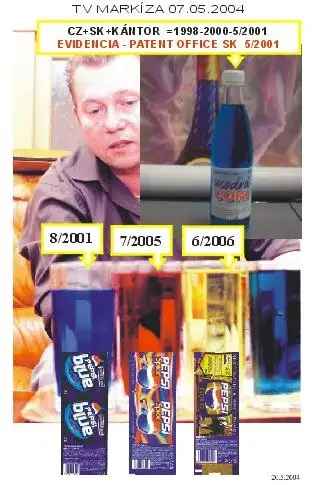
Production of the PEPSI concern
- October 2002 – production of PEPSI BLUE and delivery to the sales network in Slovakia, worldwide – in August 2001
- June 2005 – production of PEPSI SPICE and delivery to the sales network in Slovakia and probably also in the world
- June 2006 – production of PEPSI GOLD and delivery to the sales network in Slovakia and probably also in the world
In September 2007, the BRATISLAVA REGIONAL COURT set out a hearing in which I was unable to attend due to my incapacity for work and sent a notice of this situation to the court well in advance, requesting that the hearing be postponed to another date.
The court was hearing in my absence against my will and I was recognized as an unsuccessful party, which I did not know, and in October I sent a document from the Social Insurance Agency to the court about the termination of incapacity for work. An appeal was lodged against this court proceeding and its decision within the set time limit.
The deprivation of the right to appear in court will not change, among other things, the fact of the apparent admission of Pepsi-CO's Intellectual Property Representative that my right arising from the registration with the Patent Office had apparently been violated, and violated in 2002, 2005 and 2006.
In any case, I would appeal in court, where they prevented me from attending, that a color also has a visual telling value, and a change in color is a change from one state to another, and each color has its own telling value. The known state at the time of production of the pilot blue cola for Pepsi-CO was dark brown with its informative value of the known cola drink. The registration of colored cola beverages at the patent office with the production of pilot blue cola changed the production recipe and the overall character of cola beverages and their informative value.
The technique of making cola beverages is generally known, what was not known was the color solution of cola beverages. If someone wanted to test the power of colour and the law where the law applies, it is enough for a driver to run a red light at a traffic light in front of the traffic police. After being stopped by this body of state power, which is likely to happen, the driver must firmly claim that he has passed on a colour, and the law will probably be fulfilled.